Posted by eshuey on | Comments Off on Die Cutting Technologies Explained
When it comes to manufacturing precision adhesive components, gaskets, protective films and specialty materials, selecting the right die cutting technology can have a significant impact on cost, quality, production speed and scalability.
Many manufacturers know they need a die cut component, but determining how that component should be manufactured is often the more difficult decision. Should you use rotary die cutting? Flatbed steel rule dies? Solid steel tooling? Laser cutting? Or would a digital cutting table be the best solution?
The answer depends on your production volume, material characteristics, tolerances, budget, and long-term manufacturing goals.
At TPC Converting, our role isn’t simply to manufacture parts. We work alongside customers to evaluate their application and recommend the die cutting methodology that delivers the best combination of performance, efficiency, and total cost of ownership.
Different Types of Die Cutting
While all die cutting methods produce precision parts, each technology is designed for different production requirements.
Rotary Die Cutting
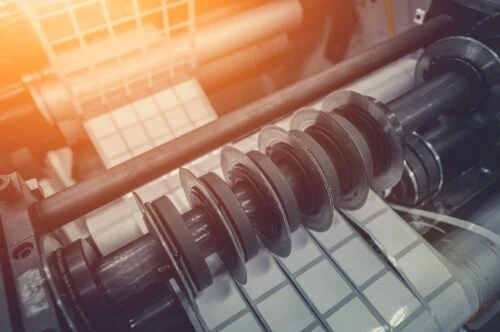
Rotary die cutting utilizes cylindrical dies mounted on a rotary press to continuously process material as it moves through the machine. This makes rotary die cutting one of the fastest and most efficient manufacturing methods for high-volume production.
In addition to cutting complex shapes, rotary presses can perform multiple converting operations during a single pass, including:
Lamination
Slitting
Sheeting
Scoring
Perforating
Liner changes
Island placement
Pneumatic knock-out
Automated stacking
Because several operations can be completed simultaneously, rotary die cutting minimizes handling, improves consistency, and reduces overall production costs.
Best Applications
Rotary die cutting is ideal for:
High-volume production
Pressure-sensitive adhesive tapes
Protective films
Labels
Medical and industrial components
Continuous roll-to-roll converting
For manufacturers producing thousands of identical parts, rotary die cutting typically offers the lowest cost per part.
Flatbed (Steel Rule) Die Cutting
Flatbed die cutting (often referred to as CNC or steel rule die cutting) uses a flat press equipped with a custom steel rule die to stamp parts from sheet material.
Unlike rotary converting, flatbed presses excel when working with thicker or more rigid materials that may not process efficiently through rotary equipment.
Steel rule tooling also provides an economical solution for medium production volumes or projects that don’t justify investing in rotary tooling.
Best Applications
Flatbed die cutting is commonly used for:
Foam materials
Rubber
Gasket materials
Thick adhesive constructions
Plastic sheets
Silicone
Fabric
Specialty materials
Because tooling costs are generally lower than rotary tooling, flatbed die cutting offers an excellent balance of flexibility and affordability.
Solid Steel Dies
Solid steel dies are precision-machined from hardened steel rather than assembled using steel rule blades.
These dies provide extremely tight tolerances and exceptional repeatability, making them ideal for demanding applications where dimensional accuracy is critical.
Although tooling costs are higher, solid steel dies often deliver longer tool life and superior consistency in high-volume production environments.
Best Applications
Solid steel dies are frequently selected for:
Tight tolerance components
High-precision electronics
Automotive components
Medical devices
Long production runs
Complex geometries
When quality requirements leave little room for variation, solid steel tooling often becomes the preferred solution.
Laser & Knife Cutting
Unlike traditional die cutting methods, laser and digital cutting systems eliminate the need for physical tooling altogether.
At TPC Converting, our knife cutting table allows us to quickly produce:
Prototype parts
Samples
Low-volume production
Design iterations
Custom one-off components
The knife cutting tables can:
Perform total cuts or kiss cuts on linered materials
Cut sheet materials
Produce gasket geometries
Punch holes
Score and fold materials
Because no tooling must be manufactured, customers can validate designs before committing to production tooling.
Best Applications
Digital cutting is ideal for:
Engineering validation
Product development
Prototype evaluation
Small production runs
Frequent design changes
For many projects, digital cutting serves as the bridge between concept and full-scale production.
This is why engineering consultation is such an important part of the process.
More Than Cutting: Complete Converting Capabilities
One advantage of partnering with TPC Converting is that we offer far more than die cutting alone.
Our in-house converting capabilities include:
Lamination
Slitting
Sheeting
Perforating
Scoring
Liner changes
Island placement
Stacking
Custom packaging solutions
By performing multiple value-added operations under one roof, we help customers reduce supplier complexity, improve quality control, and shorten lead times.
Materials We Commonly Convert
Our die cutting technologies allow us to process an extensive range of materials, including:
Pressure-sensitive adhesives
Foam tapes
3M™ VHB™ tapes
Protective films
Silicone
Rubber
Gasket materials
UHMW polyethylene
Fabric
Label stock
Plastics
Non-woven materials
Abrasive materials
Specialty engineered materials
Whether the application requires thin adhesive films or thick gasket materials, we work with customers to determine the best manufacturing approach.
Industries We Serve
Our converting expertise supports manufacturers across a wide range of industries, including:
Automotive – Precision gaskets, insulation, vibration dampening, and sealing components for Tier 1 and Tier 2 suppliers.
Appliances – Noise reduction materials, foam gaskets, seals, and assembly components that improve product performance.
Assembly & Manufacturing – Die cut adhesive solutions that streamline assembly processes while reducing labor and improving consistency.
Sign & Graphics – Precision-cut materials for dimensional signage, point-of-purchase displays, labels, and promotional graphics.
Why Work with TPC Converting?
With more than 55 years of converting experience, TPC Converting helps manufacturers evaluate every aspect of their project to determine the most efficient and cost-effective production method. Whether that means rotary die cutting for high-volume production, flatbed steel rule dies for thicker materials, solid steel tooling for precision components, or digital cutting for rapid prototyping, our team provides guidance based on your manufacturing goals.
From concept and prototyping through full-scale production, we help customers optimize their converting process.
Looking for the right die cutting solution?Contact TPC Converting to discuss your application with our converting specialists and discover which die cutting technology is best suited for your project.
Posted by TPC Converting on | Comments Off on Revolutionizing Die-Cut Adhesive Application Through Automation
Die cutting is a versatile method for cutting distinct shapes from a roll or sheet of adhesive-backed materials including foams, woven and non-woven textiles, silicone, rubbers, abrasives, paper, foils, plastic, cork, and more. These die cut pieces are used in many applications such as:
During assembly, these cutouts must be positioned and applied carefully in exact locations on or inside products or components. When performed manually, this kind of task can be time-consuming and prone to human error, which leads to production bottlenecks and waste. Fortunately, automation is helping revolutionize the labor-intensive process of applying die cut materials. Not only does this reduce cycle times, but it also improves the accuracy and quality of application.
Keep reading to learn more about the benefits of automating the die-cut adhesive application process.
Features of Automated Die-Cut Adhesive Applicator Equipment
Automation is best for processes and operations that are highly repetitive and prone to human error. Peeling die-cuts from a backing and applying them with precision without wrinkles or bubbles, over and over, is a strong candidate for automation in high-volume production. Specialized applicator equipment has several key features that are well-suited to this type of work, such as:
Opportunity to Add Assembly Aids: Converting process capabilities allow for the integration of automated assembly aids like extended liners for easy removal, pull tabs for convenient access, and zone-coated adhesives for precise bonding areas.
High-Speed Operation: Automation equipment moves quickly along pre-programmed paths, and has built-in mechanisms designed to remove die cuts from backings or carrier strips efficiently. Machines also do not require breaks, and because each application is made correctly, no time is lost removing and fixing a misaligned piece.
Precision and Repeatability: Because all of the movements of the machine are pre-programmed, they are easily repeated until the machine is told to stop. Die cuts or labels are fed into the machine from uniform rolls or sheets, so the steps involved do not change from batch to batch, achieving in-tolerance placement, sometimes within 0.002 in. It’s also possible to adjust the process as designs or products change.
Advanced Automation Technology: Features like motion control, sensors, and conveyance advance items into position, prepare and apply the die cut or protective film with appropriate force. Precision application means there are no distortions or bubbles. Then, the finished item is quickly conveyed out of the machine as the next one is loaded.
Quick Changeover: Many automated solutions include a menu of product options or are compatible with QR codes to call up new sets of pre-programmed instructions to switch from one component or type of die cut to another.
Integrability: Automated applicator machines can often be integrated into an existing assembly or packaging line. In early stages of product development, they can serve as a key component in a new automated production plan. Of course, many can also be used as standalone equipment at a workstation.
User-Friendly: Modern automation equipment is designed to be intuitive, with clear graphical user interfaces (GUIs) and simple controls. Automated equipment is intended to simplify operator tasks for streamlined loading and unloading reels or stacks of die cuts, preparing a new batch of products to be labeled, or easily switching from one task to another.
Benefits of Automating the Application of Die-Cut Adhesives
If you’re looking to increase the accuracy, efficiency, and consistency of your die-cut adhesive application process, then now is the perfect time to consider automation. Benefits include:
Less Waste: Automated equipment improves the precision and quality of die cut applications, which results in fewer misaligned or damaged pieces, less waste, and less time spent removing and reapplying incorrect die cuts.
Ease of Use: User-friendly designs and GUIs reduce the learning curve needed to become proficient with the automated process and the machine. This allows personnel to feel comfortable working with it and helps them “buy in” to automation in their daily work.
Versatility: A dedicated machine can be used exclusively for one type of product or die cut material, or it can be used with multiple shapes or types of die cuts and substrates. Fast and simple changeover makes this equipment flexible.
Cost Efficiency: Investing in a robust automated system to apply die cuts allows you to scale production or expand product offerings without compromising on quality or adding staff.
Fast Cycle Times: While manual adhesive application is a meticulous, time-consuming process, automated applicators streamline the process with pre-programmed movements that prepare and apply die cuts and labels efficiently.
Labor Management: Time and labor saved due to automation allow personnel to oversee multiple pieces of machinery or be redeployed to higher-value tasks.
Contact TPC Converting to Learn More About Automating Die-Cut Adhesive Application
Since 1967, the TPC Converting team has been an innovator in protective solutions. We work with customers in industries including construction, transportation, automotive, e-mobility, and appliances, to find efficient, cost-effective adhesive products and application processes.
Contact us to learn about our die cut adhesive capabilities and how automation can help take your operations to the next level.
Posted by TPC Converting on | Comments Off on How Die Cut Materials Are Used in Automotive Manufacturing
Precision die cutting is used to produce a wide variety of automotive components to improve the comfort, reliability, efficiency, and safety of vehicles. Offering improved flexibility and customizability, die cut materials are used in everything from EV batteries and noise reduction components to heat shielding and electronics. Keep reading to learn more about the various applications of die cut materials in the automotive industry.
EV Battery Materials
Electric vehicle (EV) manufacturers rely on quality adhesives, tapes, and encapsulation materials to secure batteries in place and protect them from the elements. At TPC Converting, we design EV battery adhesives and tapes specifically to meet the rigors of EV operation. They can be used to provide superior adhesion, insulation, and structural support for nearly any kind of EV battery.
Polyethylene terephthalate (PET) film material encapsulation
Bonding, Joining, and Fastening
For some automotive applications, die cut adhesive materials can be used in lieu of mechanical fasteners. They offer a lightweight alternative that can improve aesthetics, reduce both bulk and weight, maximize the longevity of sensitive vehicle components, and reduce assembly costs.
Common bonding, joining, and fastening applications where precision die cut adhesive products can be used in place of mechanical fasteners include:
Nameplate and emblem attachment
Exterior and interior trim attachment
Air and fluid management systems
Thermal management
Interior and exterior electronics
Structural components
Weatherstripping
Rear-view mirror and camera attachments
Noise, vibration, and harshness (NVH) reduction
Noise Reduction
Die cut parts are commonly used to manufacture acoustic insulation materials that dampen sound and vibrations for a more comfortable, quiet driving experience. The experts at TPC can custom die cut noise reduction materials based on your unique specifications, ensuring they fit seamlessly into the various components of the vehicle.
Precision die cutting can be used to produce the following types of noise-reduction materials:
Foam pads for consoles and dashboards
Felt strips for interior trim pieces
Acoustic insulation for flooring and doors
Gaskets and seals for windows and doors
Sound-deadening solutions for speaker enclosures
Adhesive-backed foam tape for securing components that may vibrate
Anti-squeak strips for window and door frames
Vibration dampeners for engine components
Rubber bumpers that reduce rattling in moving components
Heat Shielding
Engines and other automotive components create heat while in operation. If improperly managed, this heat can transfer to other areas of the vehicle and cause various issues. For example, both premature seal and gasket failure and interior overheating can result from exposure to excessive heat over long periods of time.
TPC Converting offers die-cut heat shields for various applications, including:
Floorboards
Starters
Fuel lines
Firewalls
Electronics
Die cut materials are often used to protect sensitive vehicle electronics from moisture, heat, and other harsh environmental factors. Common applications include:
Seals and gaskets for wire harnesses to prevent the entry of moisture, dust, and other contaminants from entering cables and wires
Pressure-sensitive films and tapes to hold wiring and components in place, preventing movement or vibration
Thermal gap pads, interface components, and other thermal management solutions that facilitate heat dissipation
Electrical insulating materials for mirror backings and other applications
Surface protection films that prevent scuffs, scratches, and other damage to delicate parts during transportation and installation
RFI and EMI shielding materials
Flexible graphite and other heat-spreading materials for touch screens and electronic displays
Low-emission adhesive tapes for attaching electronic components to automotive surfaces
Paint & Coating Maskings
Historically, masking techniques for automotive paint and coating applications involved manually cutting tape pieces by hand. This is a labor-intensive, time-consuming, and expensive process.
Precision die cut adhesive tapes dramatically simplify the process while increasing its efficiency and accuracy. The result is a repeatably flawless paint or coating application.
Contact TPC Converting for Automotive Die Cutting Services
If you want to benefit from top-quality precision die cutting solutions for your automotive application, TPC Converting offers a range of products and solutions. We custom-tailor every solution, whether you need tapes, labels, films, or other die cut materials.
For more information about our custom die cutting capabilities, or to get started on your custom automotive solution, contact TPC Converting today.