
Skip to Content

Tag Archive: Automotive Industry

  1. What Is Corona Treatment and How Does It Improve Adhesion in Converting?

    Comments Off on What Is Corona Treatment and How Does It Improve Adhesion in Converting?

    Corona treatment is a high‑frequency surface treatment process used in converting to increase surface energy and improve adhesion of inks, coatings and adhesives on low‑energy materials such as rubbers and foams. By modifying only the outermost surface of a substrate, corona treatment enables stronger, more consistent bonding without altering material performance.

    At TPC Converting, we provide high frequency, wide‑web corona treatment converting services; a capability offered by only a small number of converters in the United States.

    How Corona Treatment Works

    Rather than focusing on the basic definition, it’s more helpful to understand what corona treatment actually does at the material level and why it is so effective in converting applications.

    Corona treatment works by using high‑frequency electrical energy to modify only the outermost surface of a substrate. This controlled energy alters the surface chemistry by creating additional active bonding sites, allowing inks, coatings, and adhesives to interact more effectively with the material.

    Importantly, corona treatment:

    • Affects only the surface
    • Does not change thickness, strength, or flexibility
    • Prepares the material specifically for downstream converting processes

    The result is a surface that is more receptive to bonding, enabling stronger adhesion, more consistent print quality, and improved overall product performance, especially on materials that are otherwise difficult to bond.

    Why Surface Energy Matters in Adhesion and Converting

    Surface energy directly impacts how well a material bonds to inks or adhesives.

    Low Surface Energy Materials

    • Liquids bead up instead of spreading
    • Adhesives struggle to wet-out on the surface
    • Bonds are weaker and less consistent

    High Surface Energy Materials

    • Liquids spread evenly
    • Stronger molecular attraction
    • Improved adhesion and durability

    Most rubbers, foams, and polymer‑based materials naturally have low surface energy, making them difficult to print or bond without surface treatment. Corona treatment increases surface energy so adhesives and inks can perform as designed.

    Types of Corona Treatment Used in Converting

    There are multiple surface‑treatment methods used in converting, including flame treatment, plasma treatment, chemical priming, and corona discharge treatment. Among these, corona discharge treatment is the most widely used in roll‑to‑roll converting due to its speed, consistency, and process control.

    High‑frequency corona treatment is the most controlled and precise form of corona treatment. It allows converters to fine‑tune treatment levels for uniform surface energy across the entire web—especially critical for demanding adhesive and printing applications.

    TPC Converting’s High‑Frequency Corona Treatment Services

    TPC Converting offers high‑frequency corona treatment converting services for materials supplied in sheet or roll format. Our process introduces ionized gases to the material surface and applies controlled voltage to modify surface energy with precision and repeatability.

    Key Benefits of TPC’s Corona Treatment Capabilities 

    • High‑frequency corona treatment
      Provides consistent, controlled surface modification for demanding converting applications. 
    • Wide‑web corona treatment up to 62 inches
      Allows us to corona treat most extruded or coated substrates without secondary slitting, reducing handling, cost and lead time. 
    • Inline converting integration
      Corona treatment is performed as part of our converting workflow, ensuring surface preparation is optimized for downstream adhesive or printing processes. 
    • Adhesive and ink compatibility
      We corona treat materials intended for both adhesive bonding and printing applications. 
    • Dyne level testing 
      After corona treatment, we can test the dyne level of your material for a repeatable process. 

    TPC performs corona treatment every day, making it a core converting capability rather than a limited specialty service. 

    Materials Commonly Corona Treated at TPC Converting 

    Corona treatment is especially effective for materials with inherently low surface energy. At TPC Converting, we most commonly corona treat: 

    • Rubbers 
    • Foams 
    • Polymer substrates 
    • Extruded materials 
    • Coated substrates 

    Rubbers and foams are among the most challenging materials to bond due to their low surface energy. Corona treatment transforms these surfaces into bond‑ready substrates without affecting mechanical performance. 

    Why Choose TPC Converting for Corona Treatment Services?  

    If your application involves difficult‑to‑bond materials, materials with low dyne levels, unreliable adhesion, or inconsistent print quality, corona treatment is essential. 

    TPC Converting combines: 

    • High‑frequency corona treatment technology 
    • Wide‑web capability up to 62 inches 
    • Daily production experience 
    • Dyne level testing 
    • Deep expertise in adhesive and ink‑based converting 

    This allows us to deliver consistent, high‑quality surface treatment that improves adhesion and expands what’s possible with challenging materials. 

    Need Corona Treatment for Your Next Converting Project? 

    Contact TPC Converting to discuss your material, application, and surface‑energy requirements. Our corona treatment services help ensure your adhesives and inks perform exactly as intended. 
  2. Choosing the Right Pressure-Sensitive Adhesive (PSA) for Tapes and Films

    Comments Off on Choosing the Right Pressure-Sensitive Adhesive (PSA) for Tapes and Films

    The adhesive chemistry behind a tape or film significantly affects how well it bonds, how long it holds and how easily it can be removed. That’s why understanding the differences between peel adhesion, shear strength and initial tack is so important when choosing a pressure-sensitive adhesive (PSA). Each of these properties influence tape performance across different applications and adhesive types.

    What Are Pressure-Sensitive Adhesives?

    Pressure-sensitive-adhesives are a type of adhesive that become permanently tacky and will adhere to surfaces by applying pressure once they are fully dried or cured. They can be liquid or supplied in finished form as labels, tapes and films.

    The performance of PSA tapes, specifically, comes from their viscoelastic polymer structure. This allows the adhesive to flow slightly into a surface for contact while maintaining internal strength to resist stress. That balance enables PSA tapes to withstand forces like vibration and environmental exposure without losing adhesion.

    Common PSA Adhesive Types Used in Films and Tapes

    Acrylic pressure-sensitive adhesives are among the most versatile bonding solutions available. Acrylic PSA tapes are widely used because they offer a strong balance of shear strength and environmental resistance. They perform well across a broad temperature range and resist UV exposure, oxidation and many chemicals. While acrylic adhesives typically require dwell time (often up to 72 hours) to reach full bond strength, they form extremely durable, long-term bonds once fully set. Very high bond (VHB) acrylic foam tapes are engineered for demanding applications and are often used as an alternative to mechanical fasteners such as rivets or screws.

    Synthetic hot-melt rubber PSAs are formulated from synthetic elastomers and are valued for their quick set time and cost-effectiveness. These adhesives deliver strong initial tack and rapid bonding, making them well suited for temporary applications, indoor environments or high-speed production lines. However, synthetic rubber adhesives tend to have limited resistance to heat, UV exposure, chemicals and humidity. As a result, they perform best in controlled, stable environments where long-term durability is not a critical requirement.

    Natural rubber PSAs, derived from polyisoprene sourced from rubber trees, are a more premium adhesive structure within the rubber-based category. They offer exceptional initial tack, strong bonding and excellent removability, making them ideal for applications where clean removal and repositioning are important. Natural rubber adhesives also provide improved flexibility and better performance across a wider range of hot and cold temperatures compared to synthetic hot-melt rubbers. While they are more eco-friendly and highly effective for immediate bonding, natural rubber PSAs typically require additives such as resins to improve performance and have limitations when exposed to oils or prolonged high-heat conditions.

    Silicone pressure-sensitive adhesives are designed for extreme conditions. They offer exceptional temperature resistance and maintain performance in environments where acrylic and rubber adhesives fail. Silicone PSA tapes also bond well to silicone substrates and many low surface energy materials. While silicone adhesives provide excellent environmental resistance and clean removal, they tend to have lower initial tack, higher cost and shorter shelf life compared to other PSA types.

    Understanding Bond, Shear and Tack

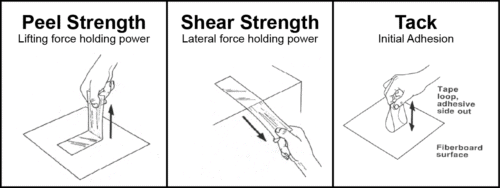
    Peel, Shear and Tack

    Bond (or peel) adhesion refers to the force required to remove a tape from a surface after it has been applied for a period of time. For protective films, a low to moderate and consistent bond strength is often preferred to allow controlled removal without damaging the surface or leaving residue.

    Shear strength describes the internal or cohesive strength of the adhesive. It measures how well the adhesive resists forces applied parallel to the bonded surface. High shear strength is critical in applications where the tape must hold weight over time without slipping or edge lifting.

    Tack is the adhesive’s ability to grab a surface immediately upon contact with light pressure. High tack is beneficial for fast application and immediate handling, while lower tack allows for repositioning during installation.

    Matching Adhesive Type to Performance Requirements

    When long-term bonding and peel strength are the priority, acrylic PSA tapes (particularly high-performance acrylic foam tapes) are typically the best choice. These tapes are engineered to deliver strong, permanent bonds and maintain adhesion under environmental stress.

    For applications that demand high shear strength, acrylic PSA tapes again offer superior performance due to their cohesive strength and durability. Silicone adhesives can also perform well in shear, especially in extreme temperature environments, but acrylic tapes generally provide higher overall strength for most industrial applications.

    If immediate adhesion is the primary concern, rubber-based pressure-sensitive adhesives are often the preferred solution. Their high initial tack allows them to bond quickly with minimal dwell time, making them ideal for temporary protection and short-term use.

    Other Factors That Influence PSA Tape Selection

    In addition to adhesive chemistry, selecting the right PSA tape requires consideration of the substrate surface energy, surface roughness, operating temperature, humidity, chemical exposure, and UV exposure. It is also important to balance initial tack with long-term bond strength and to understand how peel and shear forces will affect the application over time. Testing remains one of the most effective ways to confirm that a chosen adhesive will perform as expected in its intended environment.

    Final Thoughts

    Choosing the right pressure-sensitive adhesive is about selecting the adhesive that best matches the application requirements. By understanding how peel adhesion, shear strength, and tack differ across acrylic, rubber, and silicone PSA tapes, converters and manufacturers can make informed decisions that improve performance, reliability, and overall product quality.

  3. IATF Certification: Enhancing Our Quality Management System

    Comments Off on IATF Certification: Enhancing Our Quality Management System

    Elevating our quality management standards to new heights, TPC Converting proudly announces its IATF certification, paving the way for stronger partnerships in the automotive industry. 

    What is IATF 16949?

    IATF 16949 is a global Quality Management System (QMS) standard specifically formulated for the automotive sector. Developed by the International Automotive Task Force (IATF), it integrates existing automotive quality standards from across the world, including ISO 9001. This certification sets stringent criteria for consistent production quality and continuous improvement.  

    The IATF 16949 certification encompasses multiple clauses addressing diverse aspects of quality management, such as defect prevention, reduction of variation and waste, and ensuring that suppliers adhere to the highest standards.  

    Why is IATF 16949 Important?

    IATF 16949 certification is crucial for companies aspiring to become suppliers in the automotive industry. Most major automotive manufacturers require their suppliers to be IATF certified to ensure a consistent and high-quality supply chain.  

    This certification helps in meeting the stringent requirements of automotive manufacturers and enhances a company’s reputation in the industry, opening doors to new business opportunities and partnerships.  

    From ISO 9001 to IATF

    TPC Converting previously obtained the ISO 9001 certification, establishing a solid foundation for our quality management system. ISO 9001 focuses on various aspects of quality management, ensuring that organizations can consistently provide products and services that meet customer and regulatory requirements.  

    Building on this foundation, we have now achieved IATF 16949 certification. This transition underscores our commitment to adopting aggressive standards and integrating them into our processes, particularly in the automotive sector.  

    How IATF Certification Enhances Our Quality Management Processes

    Achieving IATF 16949 certification has significantly enhanced our quality management processes. We have revamped our inspection forms and documentation procedures to meet the rigorous expectations of the automotive industry. This includes thorough vetting and auditing of our suppliers to ensure they comply with the high standards set by major automotive manufacturers.  

    Moreover, we have refined our process for launching new parts, implementing stringent inspection and verification protocols to prevent any issues that could affect our customers’ assembly lines. Our documentation practices ensure traceability and accountability, providing our clients with the confidence they need in our products and services.  

    Building Trust with Automotive Partners 

    With our IATF 16949 certification, TPC Converting is well-positioned to build and strengthen relationships with automotive partners. This certification serves as a testament to our dedication to quality and continuous improvement, which are critical in the highly competitive automotive industry.  

    By adhering to the standards set forth by the IATF, we assure our clients that we are fully equipped to meet their stringent requirements, thereby fostering trust and long-term partnerships. Our commitment to quality management helps us meet the expectations of the automotive industry and enhances our reputation as a reliable and innovative supplier.   

    Contact us today to learn how our IATF 16949 certification can support your next project.