
The adhesive chemistry behind a tape or film significantly affects how well it bonds, how long it holds and how easily it can be removed. That’s why understanding the differences between peel adhesion, shear strength and initial tack is so important when choosing a pressure-sensitive adhesive (PSA). Each of these properties influence tape performance across different applications and adhesive types.
What Are Pressure-Sensitive Adhesives?
Pressure-sensitive-adhesives are a type of adhesive that become permanently tacky and will adhere to surfaces by applying pressure once they are fully dried or cured. They can be liquid or supplied in finished form as labels, tapes and films.
The performance of PSA tapes, specifically, comes from their viscoelastic polymer structure. This allows the adhesive to flow slightly into a surface for contact while maintaining internal strength to resist stress. That balance enables PSA tapes to withstand forces like vibration and environmental exposure without losing adhesion.
Common PSA Adhesive Types Used in Films and Tapes
Acrylic pressure-sensitive adhesives are among the most versatile bonding solutions available. Acrylic PSA tapes are widely used because they offer a strong balance of shear strength and environmental resistance. They perform well across a broad temperature range and resist UV exposure, oxidation and many chemicals. While acrylic adhesives typically require dwell time (often up to 72 hours) to reach full bond strength, they form extremely durable, long-term bonds once fully set. Very high bond (VHB) acrylic foam tapes are engineered for demanding applications and are often used as an alternative to mechanical fasteners such as rivets or screws.
Synthetic hot-melt rubber PSAs are formulated from synthetic elastomers and are valued for their quick set time and cost-effectiveness. These adhesives deliver strong initial tack and rapid bonding, making them well suited for temporary applications, indoor environments or high-speed production lines. However, synthetic rubber adhesives tend to have limited resistance to heat, UV exposure, chemicals and humidity. As a result, they perform best in controlled, stable environments where long-term durability is not a critical requirement.
Natural rubber PSAs, derived from polyisoprene sourced from rubber trees, are a more premium adhesive structure within the rubber-based category. They offer exceptional initial tack, strong bonding and excellent removability, making them ideal for applications where clean removal and repositioning are important. Natural rubber adhesives also provide improved flexibility and better performance across a wider range of hot and cold temperatures compared to synthetic hot-melt rubbers. While they are more eco-friendly and highly effective for immediate bonding, natural rubber PSAs typically require additives such as resins to improve performance and have limitations when exposed to oils or prolonged high-heat conditions.
Silicone pressure-sensitive adhesives are designed for extreme conditions. They offer exceptional temperature resistance and maintain performance in environments where acrylic and rubber adhesives fail. Silicone PSA tapes also bond well to silicone substrates and many low surface energy materials. While silicone adhesives provide excellent environmental resistance and clean removal, they tend to have lower initial tack, higher cost and shorter shelf life compared to other PSA types.
Understanding Bond, Shear and Tack
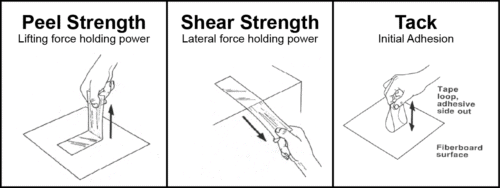
Bond (or peel) adhesion refers to the force required to remove a tape from a surface after it has been applied for a period of time. For protective films, a low to moderate and consistent bond strength is often preferred to allow controlled removal without damaging the surface or leaving residue.
Shear strength describes the internal or cohesive strength of the adhesive. It measures how well the adhesive resists forces applied parallel to the bonded surface. High shear strength is critical in applications where the tape must hold weight over time without slipping or edge lifting.
Tack is the adhesive’s ability to grab a surface immediately upon contact with light pressure. High tack is beneficial for fast application and immediate handling, while lower tack allows for repositioning during installation.
Matching Adhesive Type to Performance Requirements
When long-term bonding and peel strength are the priority, acrylic PSA tapes (particularly high-performance acrylic foam tapes) are typically the best choice. These tapes are engineered to deliver strong, permanent bonds and maintain adhesion under environmental stress.
For applications that demand high shear strength, acrylic PSA tapes again offer superior performance due to their cohesive strength and durability. Silicone adhesives can also perform well in shear, especially in extreme temperature environments, but acrylic tapes generally provide higher overall strength for most industrial applications.
If immediate adhesion is the primary concern, rubber-based pressure-sensitive adhesives are often the preferred solution. Their high initial tack allows them to bond quickly with minimal dwell time, making them ideal for temporary protection and short-term use.
Other Factors That Influence PSA Tape Selection
In addition to adhesive chemistry, selecting the right PSA tape requires consideration of the substrate surface energy, surface roughness, operating temperature, humidity, chemical exposure, and UV exposure. It is also important to balance initial tack with long-term bond strength and to understand how peel and shear forces will affect the application over time. Testing remains one of the most effective ways to confirm that a chosen adhesive will perform as expected in its intended environment.
Final Thoughts
Choosing the right pressure-sensitive adhesive is about selecting the adhesive that best matches the application requirements. By understanding how peel adhesion, shear strength, and tack differ across acrylic, rubber, and silicone PSA tapes, converters and manufacturers can make informed decisions that improve performance, reliability, and overall product quality.